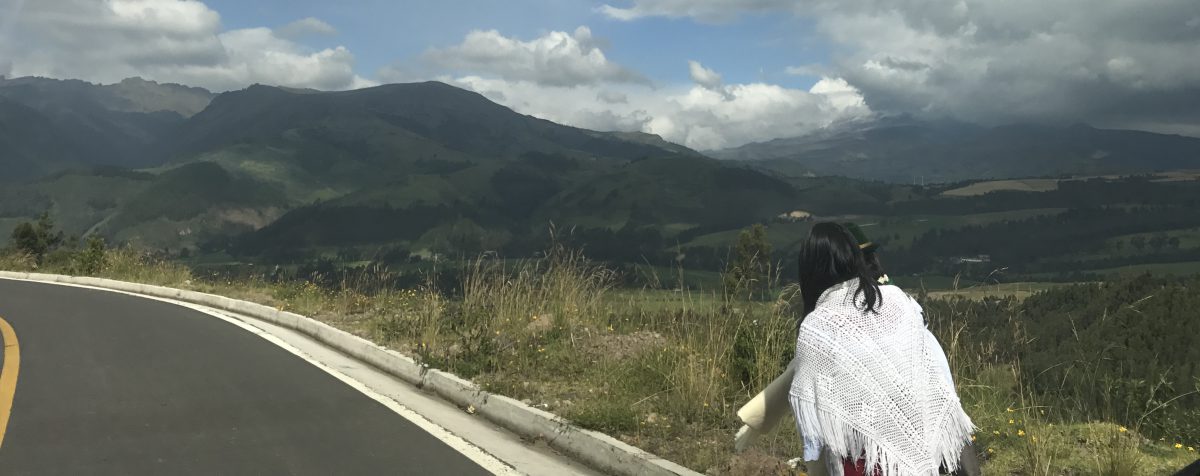

We arrived on one of the side streets and began walking towards the square (la Plaza Gutiérrez) of a city in Ecuador called Cotacachi, located at the foot of volcano Cotacachi, where we would observe one of the Inti Raymi festivals specifically reserved for children’s participation. As we approached the square, the sounds of the twin flutes, boots stomping in unison, and singing became louder and louder and drew in our group of 13. The words we had read about Inti Raymi, the summer harvest festival, were coming to life before our eyes.
Our professor, Michelle Wibblesman, focuses on the dances of the Inti Raymi in her book, Ritual Encounters, and I want to quote her description as I walk through the experience in photos that I took that day. This would be the first of many opportunities to not only witness but participate in the dances of Inti Raymi, and understanding this is central to understanding the indigenous community and culture of Otavalo:
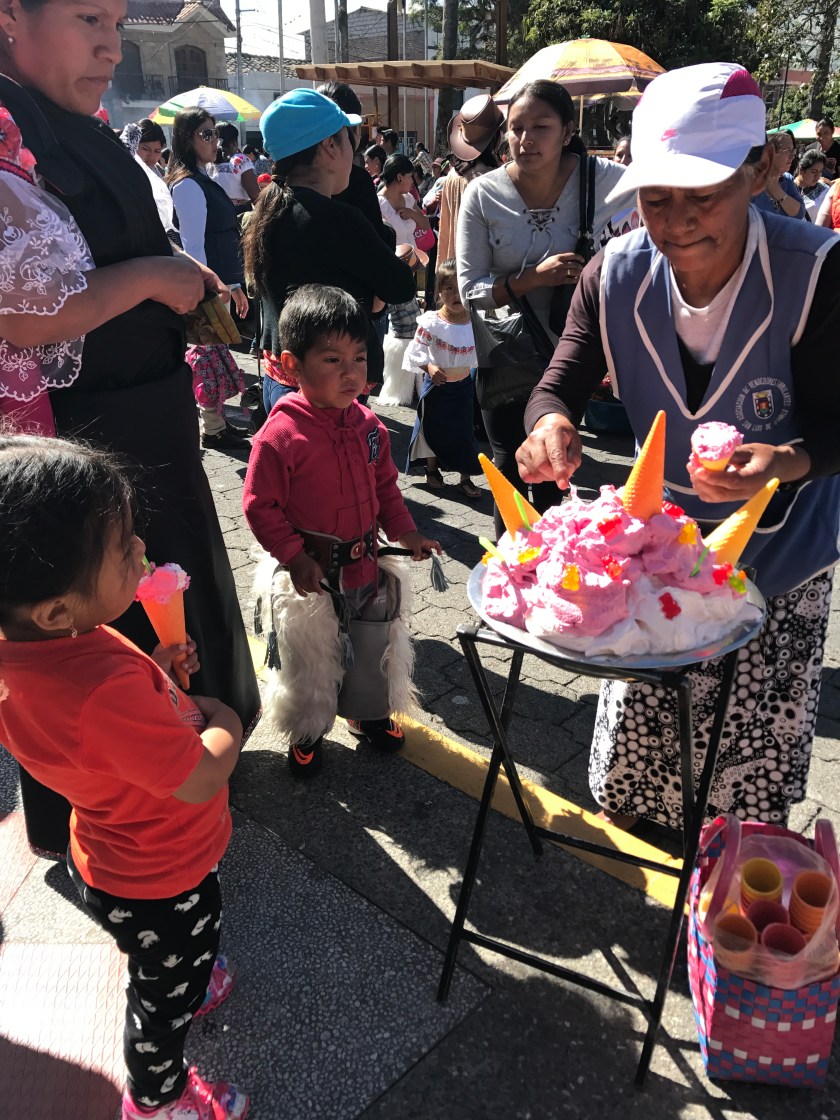
“Imaginary lines establish precise boundaries among groups, imposing a temporary festival order in the space of the plaza. The sanjuanes (dancers) dominate the street around the central park as they move in a counterclockwise direction around the plaza. Food vendors and game operators set up their stands in the central park. An indigenous public crowds the steps of the church. Local mestizo onlookers view the dancing from the safe distance of second-floor windows and balconies… A few foreign tourists weave cumbersomely around the perimeter of the event, maneuvering their cameras above the crowds…”
I actually read this chapter about the dances of Inti Raymi after we attended this festival in Cotacachi, and I thought Michelle eloquently depicted what we witnessed in Cotacachi on the children’s day of the Inti Raymi, including the awkward tourists watching from the outskirts. Later in this post, I will link videos of more rituals that accompany Inti Raymi. But first, meet Marco! The link below shows him at an Inti Raymi festival in Cotacachi. As we were enjoying the day, we noticed him sitting in the middle of the plaza with his guitar, and he agreed to have a recorded conversation with us. Later he shared more of his story with us, but in this video, he’s talking about Inti Raymi being the largest festival of four. All kinds of people come–indigenous, mestizo, blacks, “tourists like you,” he says. He explains that the point of the festival is to celebrate energy and from where it comes and to be grateful of nature. To recuperate Pacha Mama (Mother Earth). At the end he identifies himself as Kichwa, but he knows Spanish and little English as well.


Ritual Dances
Something I am not sure I understood until after experiencing it myself, is that these celebrations are among several ongoing “ensemble of rituals” that are connected to the Festival of the Sun. In other words, there isn’t just one day set aside for Inti Raymi celebrations. The Summer Solstice is June 21st, but the celebrations last for days, and Kichwa word “Inti Raymi” literally means “sun ritual.” It is important to note that this post presents my limited view of Inti Raymi based on the two weeks I spent in Otavalo. Sharing and documenting my interaction with this meaningful cultural experience has helped me to process the required readings, but I am in no way attempting to speak authoratatively on these rituals. It was very clear, however, that the time we spent in Otavalo was, not by coincidence, in the heart of Inti Raymi, which was significant in gaining an understanding of the Andes. That our group was able to be present for these colorful traditional rituals made real our understanding of the values represented by the indigenous community.
By the way, this post is very much “looking forward into the past,” an Andean “way of knowing” in which I am literally, (in my mindset) looking back on the experience and still having these aha moments. When I was in the Andes, I never knew what to expect, which, I think is what made the experience rich. We were constantly reflecting on the experiences as they happened (looking back). As each new day happened, I’m not sure about my colleagues, but I know that I, personally, was processing everything by attaching meaning and making connections with what I had learned in the lectures, or the readings, or the kichwa songs we were learning, or the ritual cleansings, etc. Everything was connected. Even as I am blogging about rituals associated with Inti Raymi, I find that the Andes view of time and space being cyclical makes a lot of sense – comforting, even! Rather than the future being in front of me, it’s behind me (a very mysterious future that lies behind not ahead). This should make for some very interesting lesson plans this year. ;
Ritual Thanksgiving
As I mentioned, our group was present for the date of the Summer Solstice, and this timing brought many opportunities for witnessing and even participating in the rituals associated with the festival.
I am going to try and walk you through one experience, known as Pacha Manka, that accompanied our Inti Raymi experience.
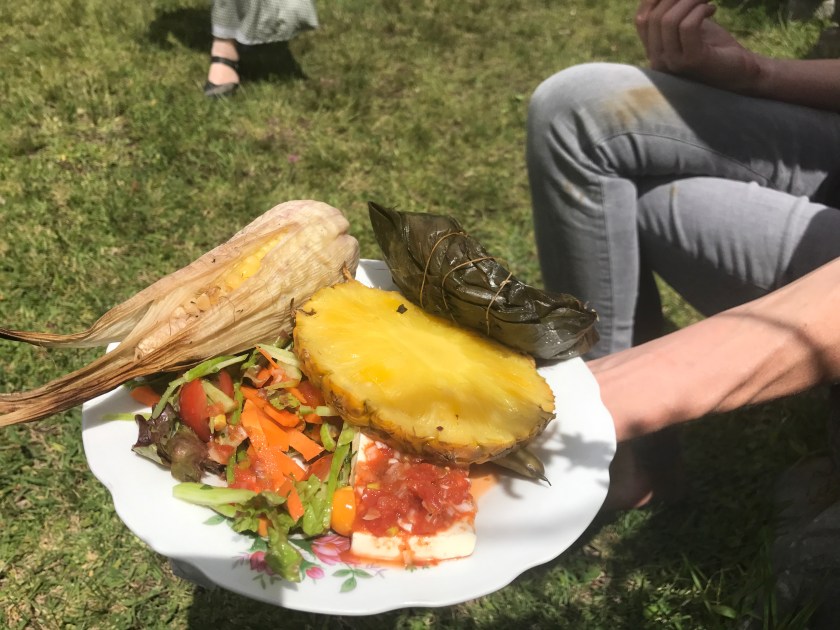
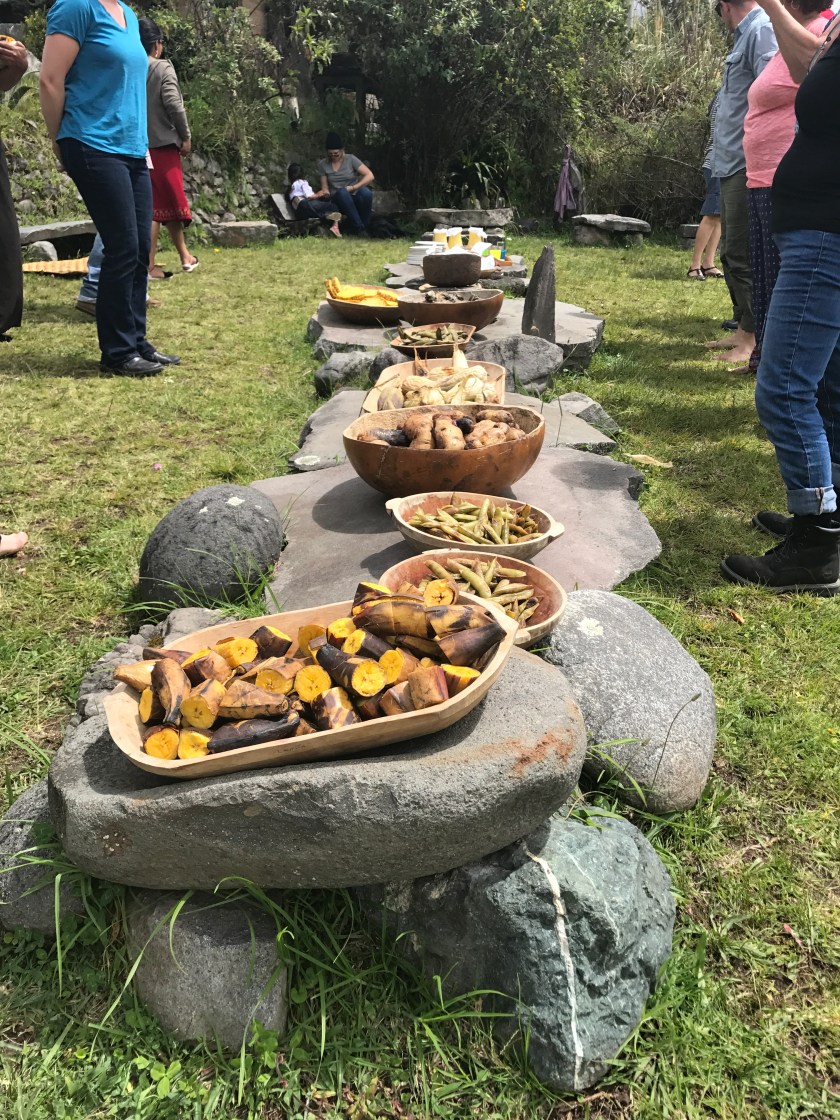
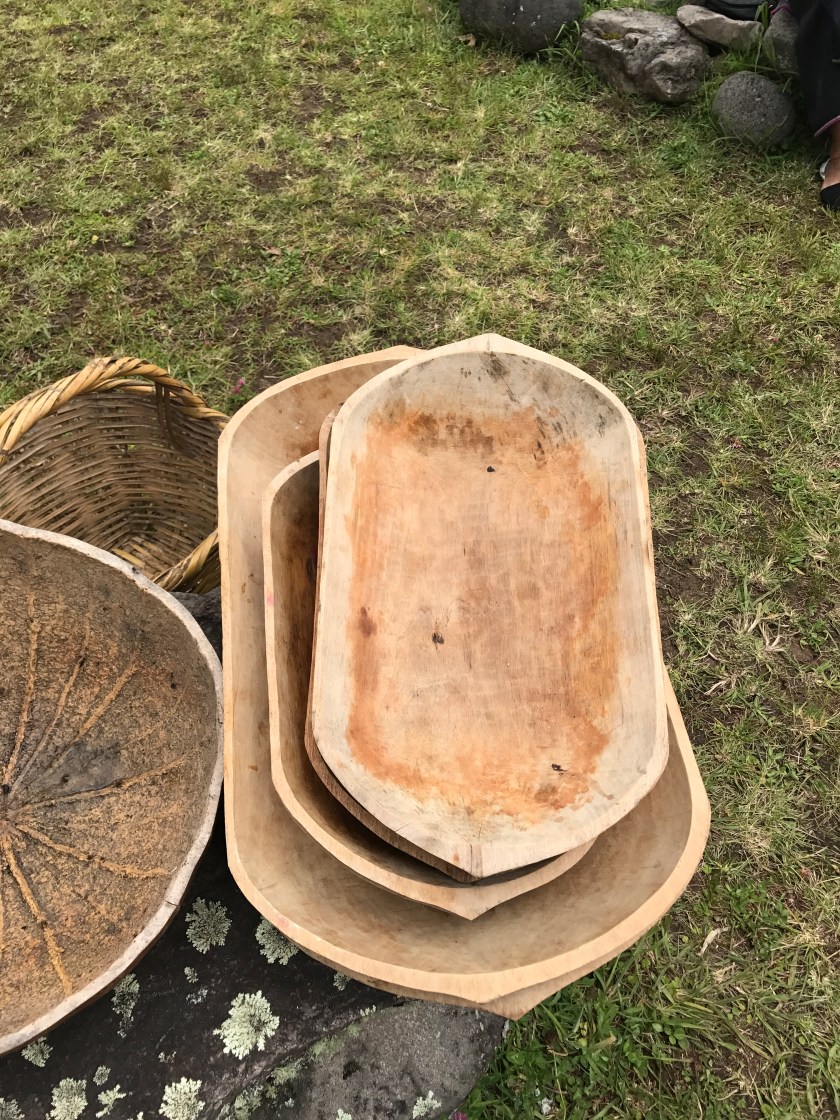
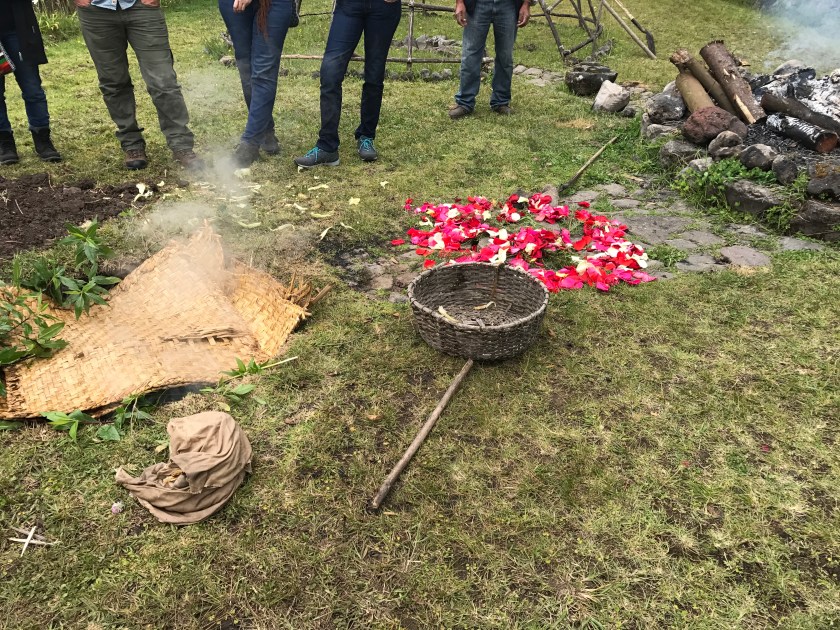
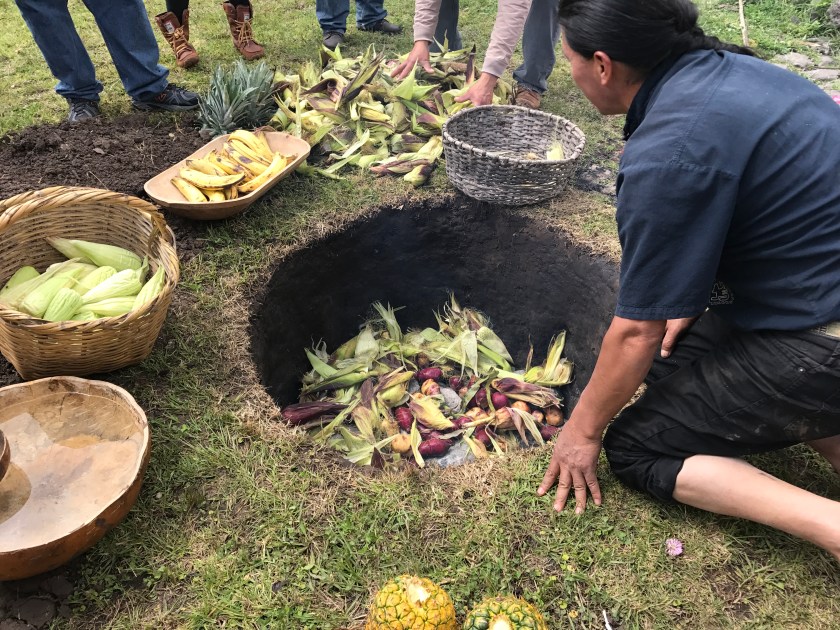
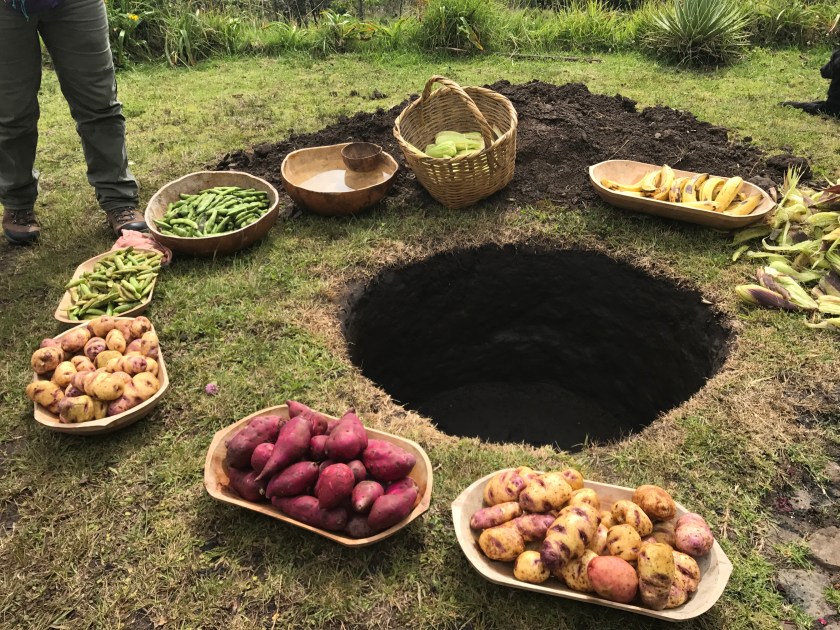
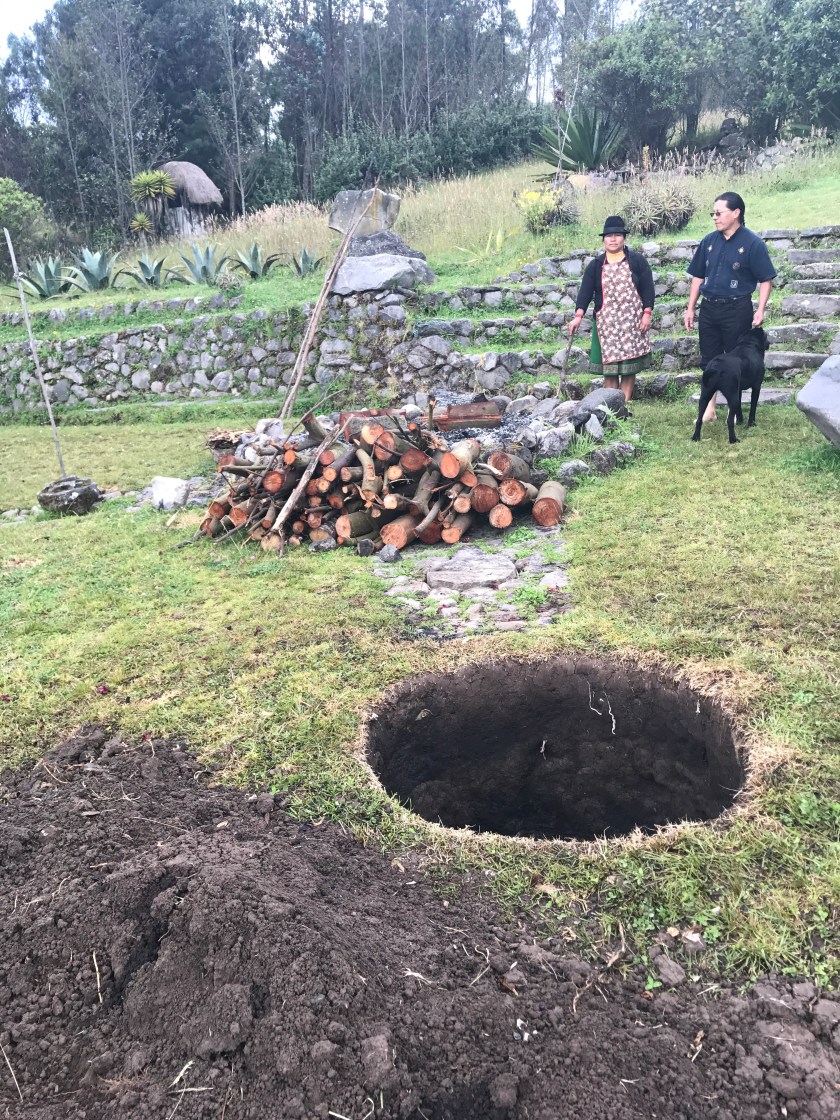
The pictures posted below begin with the end result (my plate of food!) and follows in reverse consecutive order to our arrival at San Clemente . We arrived early one morning at a mountainside location which serves as a cultural center as well as lodging for tourists. Our host directed us to gather wood, and one by one we added wood to the huge pile. Before lighting the fire, each of us chose a volcanic rock and offered a wish before placing it as the foundation. I remember that our host explained that we were starting fire with something that had come from the earth. We added logs to make a house honoring the four directions of the compass. We took care of the fire to make sure it continued to burn. A few feet away, there was a mud pit, whose location was significant in relation to the sun. The volcanic coals which we had placed on the fire to burn were later transferred to the put and served as the foundation and source of heat for the harvest. Bananas, pineapples, potatoes, corn, and fava beans were all added to the mix, or what I like to call an Andean crockpot. Corn husks and branches from nearby eucalyptus trees were used as an extra layer to preserve the moisture. We added a moist canvas to the top, and shoveled dirt to seal in the heat. Then, we danced in a circular motion on the surface of the earth (with the harvest underneath) and sang songs along with a live Andean ensemble. Around 3 hours later, as if a film was rewinding, we shoveled the dirt from the top, removed the canvas, and literally dug the cooked items out of our “crockpot,” one potato at a time. Zach and Aryn practically fell in the pit digging our food out. Wooden trays were set out for serving trays, and an offering of thanksgiving was made. This was a ritual of thanksgiving to Pacha mama (Mother Earth) and Father Fire, and for the food produced by their union.






Ritual Baths
During Inti Raymi, members of the indigenous communities go to local springs, rivers and waterfalls to undergo ritual spiritual purification, which they believe results in a renewal of energy and a strengthening of their relationship with Mother Nature. In Otavalo, this ritual takes place at midnight in the nearby waterfall that is considered to be sacred. Our group had the opportunity, on June 21st, to encounter this ritual at a site in the foothills of Mama Cotacachi. Some members of our group participated in the ritual (including me) and received a blessing from the shaman, who, in Andean indigenous cultures, acts as an intermediary between the natural and supernatural worlds. In western culture I would compare this to a priest, but I’ve gleaned from this experience to find meaning in the moment without making direct comparisons to what I understand in my own culture. Evidence of religious syncretism is prevalent in the Andes indigenous cultures because of the influence of Spanish religion and culture brought to the region in the 1500s. I was surprised to that I actually understood the language used during the blessing (en el nombre de padre, del hijo, y espiritu santo) and prayers. In participating in any rituals in Ecuador, I found myself clinging to what meaning I could grasp, and I appreciated this connection to words I knew and understood in these moments. Listed below are a few of the elements of the ritual cleansing that added to this sensory and memorable experience:
- Frigid waters (this is the Andes, after all!) – Recipients of the blessing stood in the waters, and the shaman doused each of them one by one with water from the sacred waters (from head to toe!)
- Stinging Nettle (used for a means of chasing out negative energy) – The shaman brushed the literal “stinging” plant across the arms of each person ( I actually got a rash afterwards, but it went away the next day).
- “Florida” water (liquid of flower petals and bitters) – The shaman sips and then “annoints” or blows it on you before he gives you a blessing.
- Palo santo smoke – In Spanish, the name literally means, “holy wood.” I’ll admit, when I was breathing in the incense from this, I didn’t know the Spanish word, but I love the translation. When participating in indigenous rituals in which the language is unfamiliar, the more sensory the experience, the better! The pleasant, fresh smoke completed the cleansing routine as members stepped out of the cool sacred waters.
- Offerings for Pacha Mama (Mother Earth). Fruits breads and flower petals covered a blanket, and prayers were offered in thanksgiving as a closing to this cleansing ritual.
- People communing with one another and with nature. For me this aspect is an important one to mention in describing this experience. People were joining together in this place for the common good and for the same purpose. They were chatting and laughing and taking care of one another (and their pets). One of our group members sat down and conversed (in Spanish) with one of the indigenous community members and was so distracted she didn’t even know half of us had participated in the ritual cleansing. It was casual, yet sacred, and all of us could feel the gratitude expressed as one whole.


 Teaching the Andes